Rehabilitation
Rehabilitation after ChondroFiller, by defect site.
The manufacturer’s phased tables for load, mobilisation and activity after ChondroFiller® liquid implantation, transcribed by defect site, with the early post-operative regimen from the surgical technique guide.
Principles
Four things every protocol shares.
The joint is immobilised in an orthosis for 48 hours after wound closure.
Partial loading builds over 6 to 8 weeks, set by the defect location and the surgeon.
Continuous passive motion features in every protocol in the first weeks.
Return to high-load or contact sport is a decision for month 6 onwards, or later.3,2
Manufacturer’s note
Early post-operative regimen
Grouped by loading pattern in the technique guide.
The surgical technique guide distinguishes defects in the main load-carrying area, loaded axially, from defects on the patella or trochlea, loaded only in flexion. Its programme follows the recommendations of the German trauma and orthopaedic societies.2
Main load zone: femoral condyles and talus
- Mobilisation from day 2 after surgery
- 20 kg partial load on the operated limb for 6 weeks
- CPM for one hour at least twice a day
- From week 7, build load to 30 kg, then over two weeks to full load
- Cycling and swimming once full load is reached; careful muscle building through isometric training
- Jumping, running and contact sports after one year
Patella and retropatellar surface
- Mobilisation from day 2 after surgery
- Flexion limited to 0-0-30° by an IROM splint for 3 weeks
- 20 kg partial load for one week; full load allowed after week 2
- From week 3, increase flexion by 30° every two weeks; remove the splint from 90°
- Cycling and swimming from 90° flexion; careful muscle building through isometric training
- Sports with a high risk of falling after one year
Phased protocols
Load, mobilisation and activity by period.
Transcribed from the manufacturer’s rehabilitation guidance for four defect sites. Orthosis examples named in the guidance are the manufacturer’s, not Actomed’s.
Source for every table below:1
Femoral condyle defects
Knee, main load zone
| Period | Load | Mobilisation | Activity and rehab |
|---|---|---|---|
| Weeks 1 to 6 |
|
|
|
| Weeks 6 to 12 | Increase towards full body weight at 15 to 20 kg a week |
|
|
| Months 3 to 6 | Full load | Without restriction | Light sports activities |
| Month 6 onwards | Full load | Without restriction | Sports involving high loads |
Patellofemoral defects
Knee, patella and trochlea
| Period | Load | Mobilisation | Activity and rehab |
|---|---|---|---|
| Weeks 1 to 8 |
|
| Water gymnastics and swimming |
| Weeks 8 to 12 | Increase to full load within two weeks | Free mobility, limited only by pain |
|
| Months 3 to 6 | Full load | Without restriction | Light contact sports |
| Month 6 onwards | Full load | Without restriction | Normal contact sports |
Talar defects
Ankle
| Period | Load | Mobilisation | Activity and rehab |
|---|---|---|---|
| Weeks 1 to 6 |
| Immobilise, then passive, assisted and active movement |
|
| Week 6 to month 3 | Gradual increase in load to 100% | Without restriction, full range of movement |
|
| Months 3 to 6 | Full load | Without restriction | Light sports such as swimming and cycling |
| Month 6 onwards | Full load | Without restriction | Full sports activity |
Hip defects
Hip
| Period | Load | Mobilisation | Activity and rehab |
|---|---|---|---|
| Weeks 1 to 6 |
|
|
|
| Weeks 6 to 12 | Increase by 10 to 20 kg a week to full load by week 12 | Passive and active mobilisation, free mobility |
|
| Weeks 13 to 16 | No jogging | Without restriction |
|
| Month 6 onwards | Full load | Without restriction |
|
The source document
Download the manufacturer’s guidance.
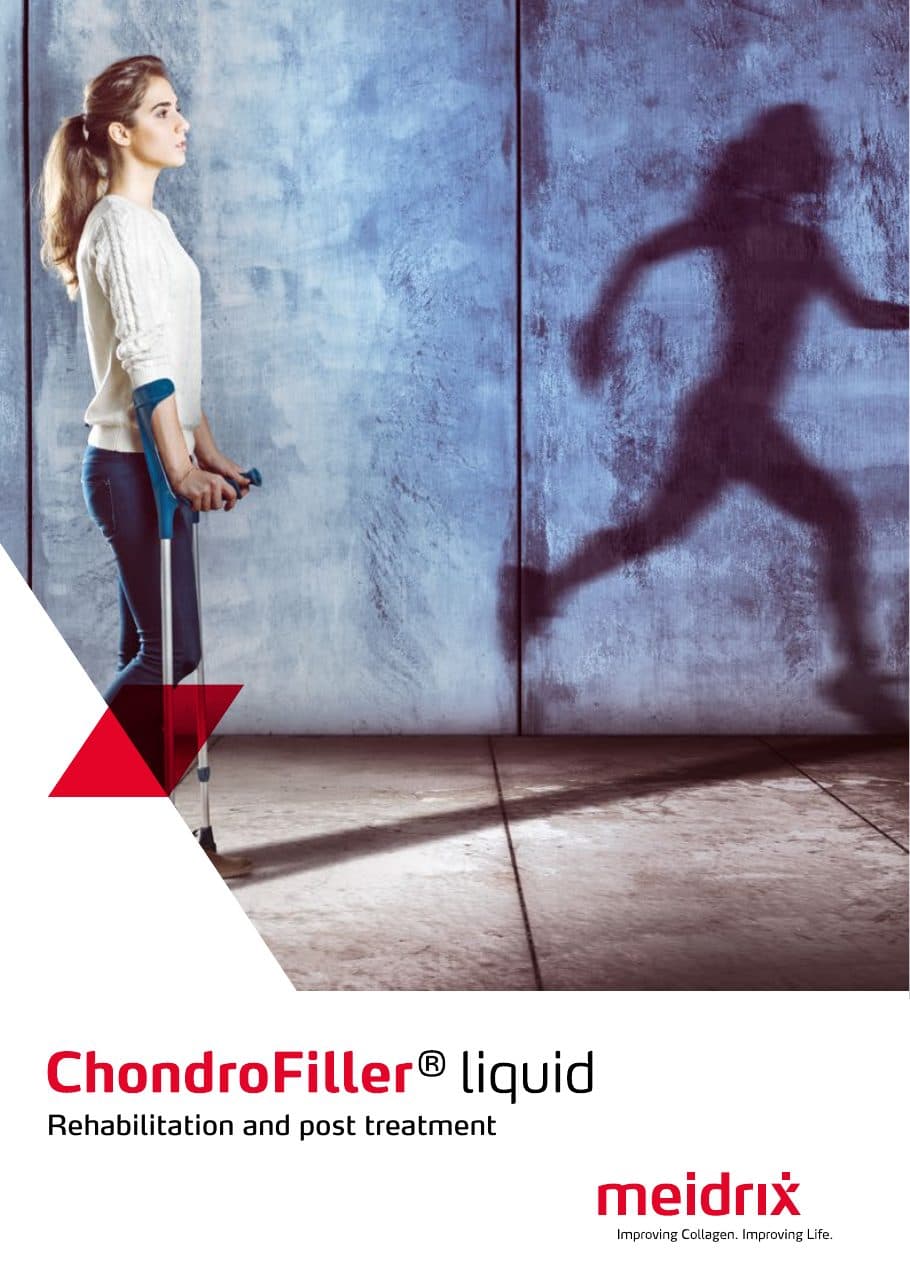 Rehabilitation
Rehabilitation and post treatment
6 pages
Phased load, mobilisation and activity tables for femoral, patellofemoral, talar and hip defects.
Copy hosted by Actomed
Open PDF
References
- 1.Meidrix Biomedicals GmbH. ChondroFiller rehabilitation guidance. Manufacturer publication, 2022. View source
- 2.Meidrix Biomedicals GmbH. ChondroFiller® liquid surgical technique. Manufacturer publication, 2022. View source
- 3.Meidrix Biomedicals GmbH. ChondroFiller® liquid patient education leaflet. Manufacturer publication, 2022. View source