What to expect
What happens before, during and after keyhole surgery.
This page explains what to expect if you and your surgeon decide to go ahead with ChondroFiller® liquid: the appointments, the keyhole procedure and your recovery.

Step by step
What happens, from consultation to follow-up.
Step 01
Consultation and imaging
A surgeon assesses your joint, your history and your scans, and discusses whether ChondroFiller is worth considering for you.
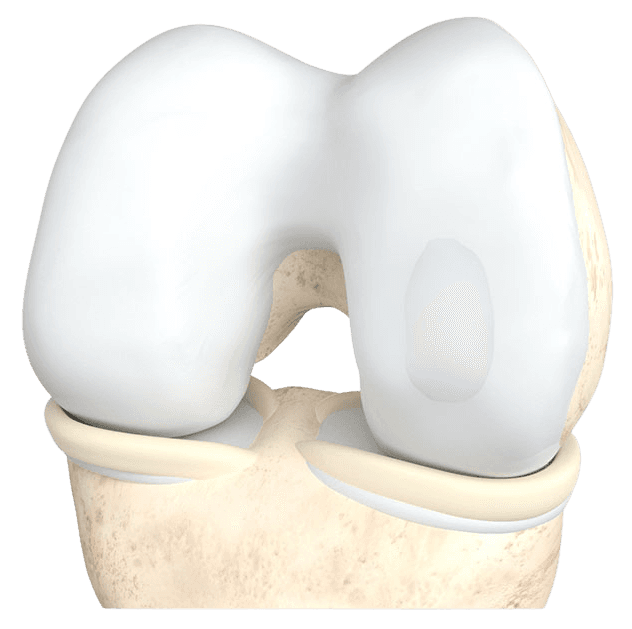
Discussed with your surgeon alongside your scans, illustrative Step 02
Decision with the surgeon
You and your surgeon decide together whether to go ahead. Clinics set their own fees; ask the clinic.
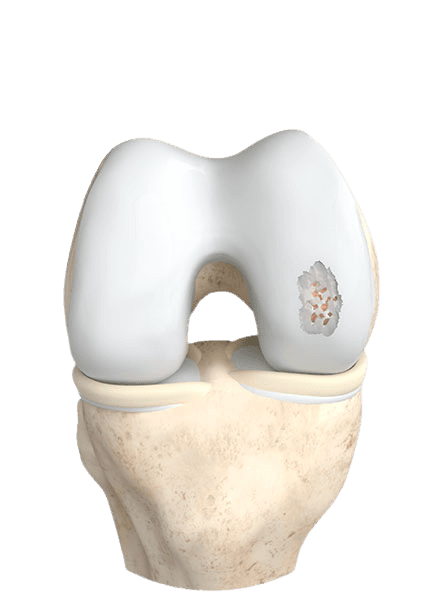
Your surgeon confirms the defect before deciding together, illustrative Step 03
Keyhole procedure
During keyhole (arthroscopic) surgery, the surgeon prepares the cartilage defect and places ChondroFiller into it, where it forms a gel within minutes.
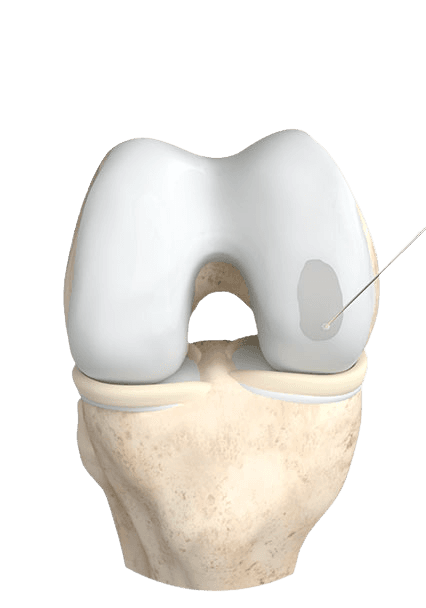
ChondroFiller is applied into the prepared defect during keyhole surgery, illustrative Step 04
Recovery and follow-up
Your surgeon will talk you through aftercare and arrange follow-up.
Prepare for your consultation
Questions to ask your surgeon
- 1What do my scans show, and is ChondroFiller an option for my joint?
- 2What will you do if it turns out to be larger than expected once you are in the joint?
- 3What is your experience with this implant?
- 4What does recovery involve?
- 5What are the alternatives?
- 6What will it cost at this clinic?
Recovery
What the manufacturer says about aftercare.
The manufacturer publishes rehabilitation guidance for clinics and patients to follow after ChondroFiller is used.1
Your surgeon sets your rehabilitation plan.

After the wound is closed, the joint is held still in a brace (an orthosis) for 48 hours.2
Weight goes back through the joint gradually, over about 6 to 8 weeks, following your doctor’s instructions.2
Return to sport comes later and depends on the joint and the defect; the manufacturer’s tables put high-load sport at six months or beyond.1
Risks
What the manufacturer reports about risk.
The manufacturer states: 'In rare cases, hypersensitivity reactions to collagen such as allergic or inflammatory reactions can occur.' No adverse events were reported in the published multicentre trial of 23 randomised patients, 13 of whom received ChondroFiller. If you notice anything you are concerned about after treatment, contact the clinic that treated you.2,3
Report any concern to your clinic; product concerns can also be reported to Actomed, the UK Responsible Person.
Studies mentioned on this page
- 1.Meidrix Biomedicals GmbH. ChondroFiller rehabilitation guidance. Manufacturer publication, 2022. View source
- 2.Meidrix Biomedicals GmbH. ChondroFiller® liquid patient education leaflet. Manufacturer publication, 2022. View source
- 3.Schneider U. Controlled, randomized multicenter study to compare compatibility and safety of ChondroFiller liquid (cell free 2-component collagen gel) with microfracturing of patients with focal cartilage defects of the knee joint. Video Journal of Orthopedics Surgery, 1:1-8, 2016. View DOI
Find a clinic that offers ChondroFiller
Actomed supplies ChondroFiller and trains clinic teams to use it. Actomed does not assess or treat patients, does not recommend one clinic over another, and being seen by a clinic is not a decision to go ahead with treatment.